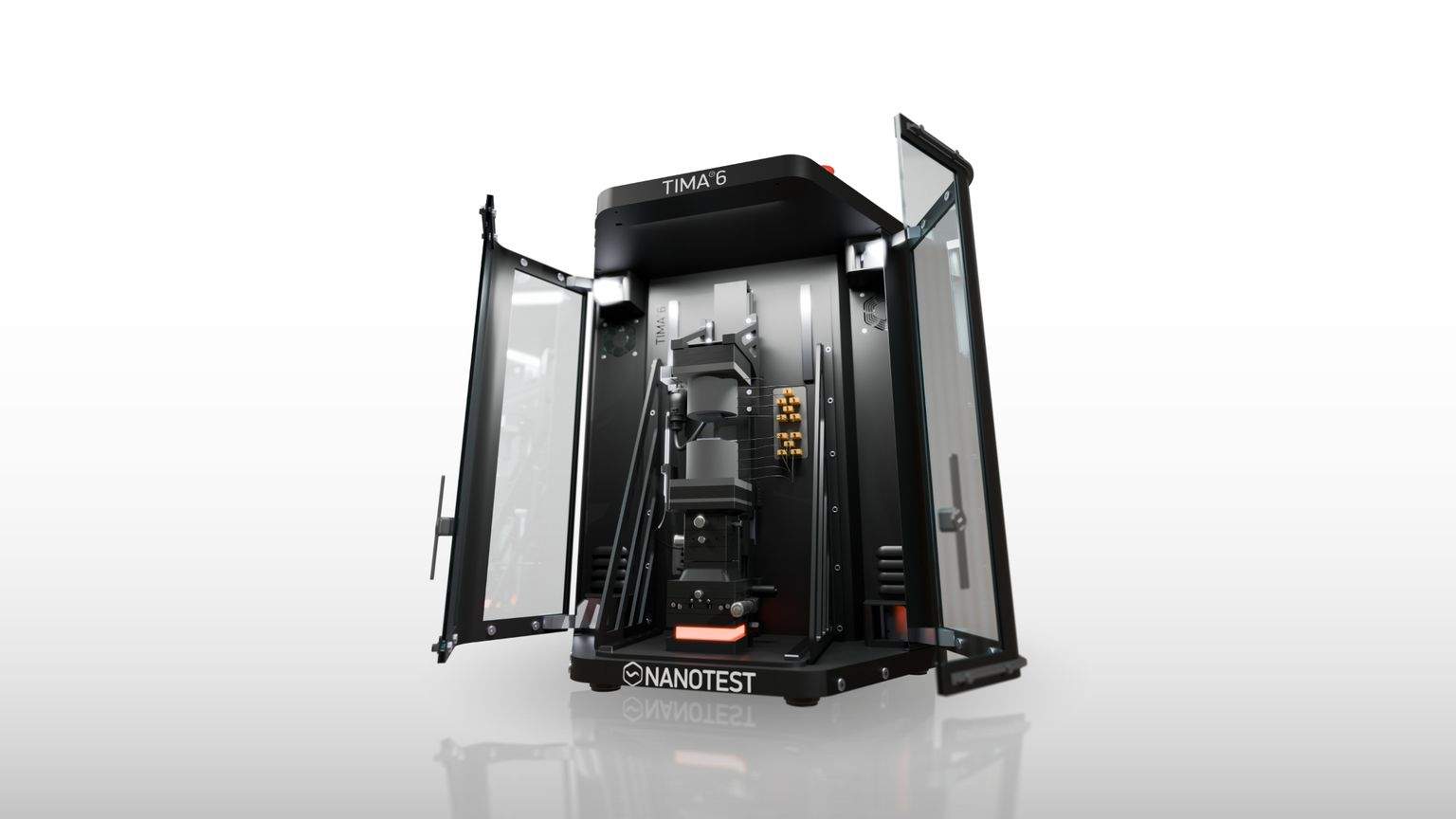
TIMA
Thermal Interface Material Analyzer
TIMA follows the ASTM D5470 standard for the thermal characterization of gap fillers, greases, pads, foils, adhesives, underfills, substrates and many more.
TIMA systems are benchtop measurement platforms for the thermal characterization of thermal interface and related materials. They measure effective thermal resistance, bulk thermal conductivity and thermal interface resistance under controlled mechanical and thermal boundary conditions.
For engineering teams, TIMA provides more than a single conductivity value. It helps quantify how a material behaves under pressure, temperature, bond-line thickness and aging conditions — the parameters that determine whether a TIM performs reliably in the final application.
Choose the Right TIMA System
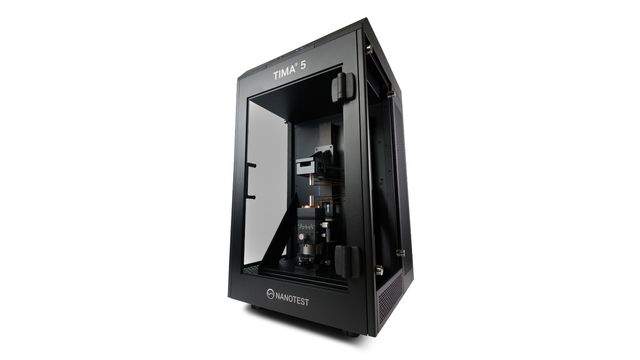
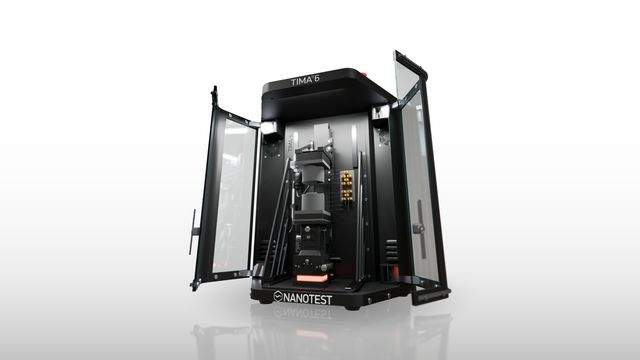
The TIMA 5 and TIMA 6 models share the same core measurement philosophy, but are optimised for different testing requirements. TIMA 5 is the compact choice and already exceeds the ASTM D5470 standard, offering reliability testing with flexible thermal and mechanical control. TIMA 6 is the advanced platform for broader sample sizes, higher force conditions, higher sample temperatures, improved resolution, and multivariable reliability testing.
Beyond ASTM D5470
Using the ASTM D5470 standard TIMA measures the effective thermal resistance and conductivity of a sample, as well as the bulk thermal conductivity and thermal interface resistance.
The system allows to investigate these parameters under varying mechanical and thermal properties, helping engineering teams to evaluate TIM properties under application specific conditions.
In addition cycling thermal and mechanical parameters allows investigating aging related pump out, dry out, delamination and void formation.
TIMA enables TTV testing, providing authentic TIM1 application data. Thermal test vehicles (TTVs), enable thermo-mechanical cycling that reproduces the warpage behaviour of real packages, thereby enabling realistic long-term reliability testing.
ASTM D5470 Testing Workflow
In the ASTM D5470 measurement principle, the sample is placed between two metal test heads with known geometry and physical properties. The system measures the temperature gradient and heat flow through these test heads and thereby calculates the effective thermal resistance of the sample.
By repeating the measurement at multiple bond-line thicknesses, the relationship between thermal resistance and thickness can be fitted linearly. This fit separates the bulk contribution of the material from the interface contribution.
Controlable Paramters
Mechanical
- Pressure [psi, kPa]
- BLT [µm]
- Compression speed [µm/s]
Thermal
- Sample temperature [°C]
- Temperature gradient [°C]
- Heatflow [W]
- Heat flow density [W/mm²]
Temporal
- Steady state definition
- Dwell time
Applications
TIMA systems are used wherever thermal interface performance must be measured, compared or qualified under controlled conditions. Typical applications include TIM supplier evaluation, thermal material development, power electronics, semiconductor packaging, EV and automotive electronics, module qualification, underfill and adhesive evaluation, interface quality studies and long-term degradation analysis.
For R&D teams, TIMA supports material comparison and formulation development. For validation teams, it supports performance verification under defined mechanical and thermal conditions. For reliability teams, it helps quantify aging behavior and degradation mechanisms over time.
Why Nanotest TIMA
TIMA combines controlled thermal characterization, mechanical loading, thickness monitoring and automated measurement workflows in compact benchtop systems. This makes it suitable for engineering teams that need repeatable data without building custom test infrastructure for each material or application.
The platform is especially valuable when a simple thermal conductivity value is not enough. By analyzing pressure dependence, temperature dependence, bond-line thickness dependence and aging behavior, engineers can move from nominal material selection toward application-relevant qualification.
TIMA FAQ
What is the difference between TIMA 5 and TIMA 6?
TIMA 5 is the compact ASTM D5470-compliant system for thermal characterization of TIMs and other low- to mid-conductivity materials. TIMA 6 extends the platform with larger sample size capability, higher continuous and short-term force, broader sample temperature range, higher resolution and expanded TTV testing.
Which values does TIMA measure?
TIMA measures effective thermal resistance and effective thermal conductivity aswell as bulk thermal conductivity and thermal interface resistance.
Which materials can be tested?
Supported materials include thermal interface materials like pastes, greases, phase change materials, liquid metals, gap pads, gap fillers, foils, sheets, adhesives, cured materials, mold compounds, underfills, substrates and interposers.
Can TIMA be used for aging and reliability testing?
Yes. TIMA systems support aging behavior testing. TIMA 6 specifically supports accelerated lifetime characterization under defined thermo-mechanical load profiles or power conditions and monitors thermal resistance evolution over time
Not Sure Which TIMA System Fits Your Test Case?
The right TIMA configuration depends on the material type, sample geometry, temperature range, pressure range, desired measurement output and reliability test profile. Send us your material class, sample dimensions and target operating conditions. We will help you identify whether TIMA 5 or TIMA 6 is the better fit for your measurement task.