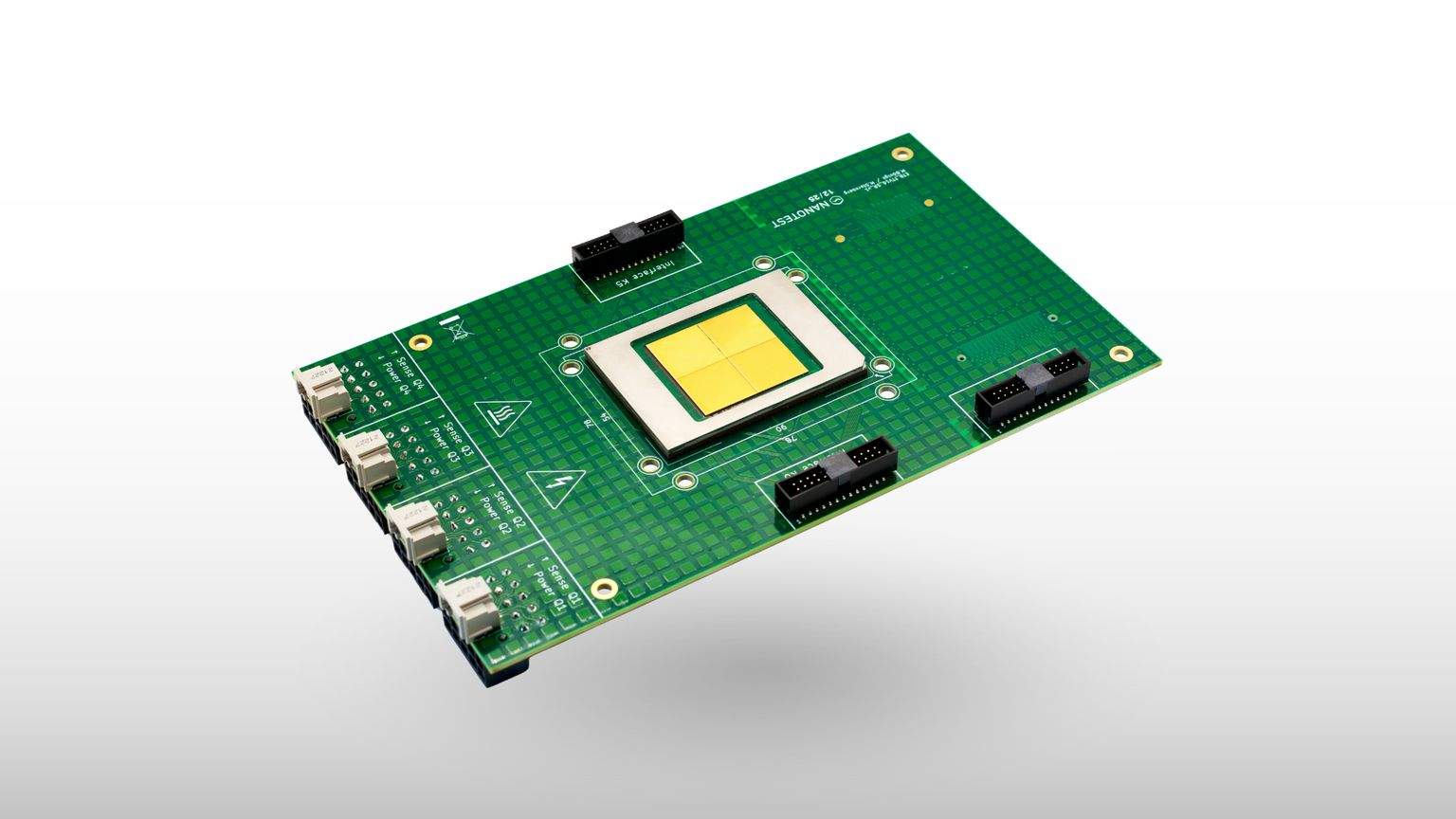
The TTV16 Thermal Test Vehicle is designed to replicate the thermal and electrical behavior of modern high-performance CPU architectures in a controlled laboratory environment. With a large 40 × 40 mm die area and support for both monolithic and chiplet configurations, the TTV16 enables engineers to move beyond simplified heat sources and instead work with realistic, spatially distributed thermal loads.
Its combination of up to 24 independently controllable heater zones and 56 integrated on-die temperature sensors makes it a powerful platform for validating cooling concepts, package designs, and system-level thermal strategies under conditions that closely reflect real silicon behavior.
Built for Real CPU-Class Thermal Complexity
Modern processors no longer behave like uniform heat sources. Power density varies dynamically across cores, cache regions, and chiplets, creating localized hotspots and strong thermal gradients. The TTV16 is engineered specifically to reproduce this behavior at a physically meaningful scale.
Up to 24 heater zones can be addressed independently, allowing engineers to reconstruct realistic workload patterns or stress scenarios. In parallel, 56 embedded RTD sensors provide high-resolution thermal feedback directly from within the die, enabling precise mapping of gradients, spreading effects, and cooling asymmetries.
Available in monolithic or chiplet configurations, the platform supports both integrated die-level studies and multi-die system emulation—making it equally relevant for next-generation CPU design and advanced packaging research.
Performance at a Glance
- Up to 5000 W total package power for extreme thermal load emulation
- 24 independently controllable heater zones for spatial power distribution
- 56 integrated on-die RTD sensors for high-resolution thermal mapping
- 40 × 40 mm CPU-scale die area (monolithic or chiplet configuration)
Engineered for System-Level Thermal Validation
The TTV16 is built for engineers working at the intersection of silicon, packaging, and cooling system design. It supports validation of high-performance thermal solutions where uniform assumptions fail and localized thermal effects dominate system behavior.
Typical use cases include advanced CPU and GPU thermal emulation, chiplet-based architecture development, liquid cooling system validation, vapor chamber and cold plate benchmarking, and high-density power electronics research. It is particularly suited for teams that need to de-risk thermal performance early in the design cycle with credible, repeatable data.
MUX Board connection
Nanotest’s multiplexer unit board enables efficient signal routing for all 56 integrated sensors without the need for the hundreds of individual cables that would otherwise be required for powering and reading each sensor. By sequentially switching between sensor channels, the multiplexer drastically reduces wiring complexity, minimizes potential interference, and simplifies experimental setup. The board connects directly to the backside of the TTV16 ETB, ensuring a compact, robust, and reliable interface between the thermal test vehicle and the measurement equipment. This design not only streamlines signal management but also improves measurement stability and maintainability during extended test campaigns.
Speak with a Thermal Test Specialist
Whether you are planning a full measurement system with control electronics, integrating chiplet-based test structures, or defining a custom thermal validation workflow, Nanotest can support your development process from concept to deployment. Contact us to discuss your application and configure the right TTV16 setup for your testing environment.