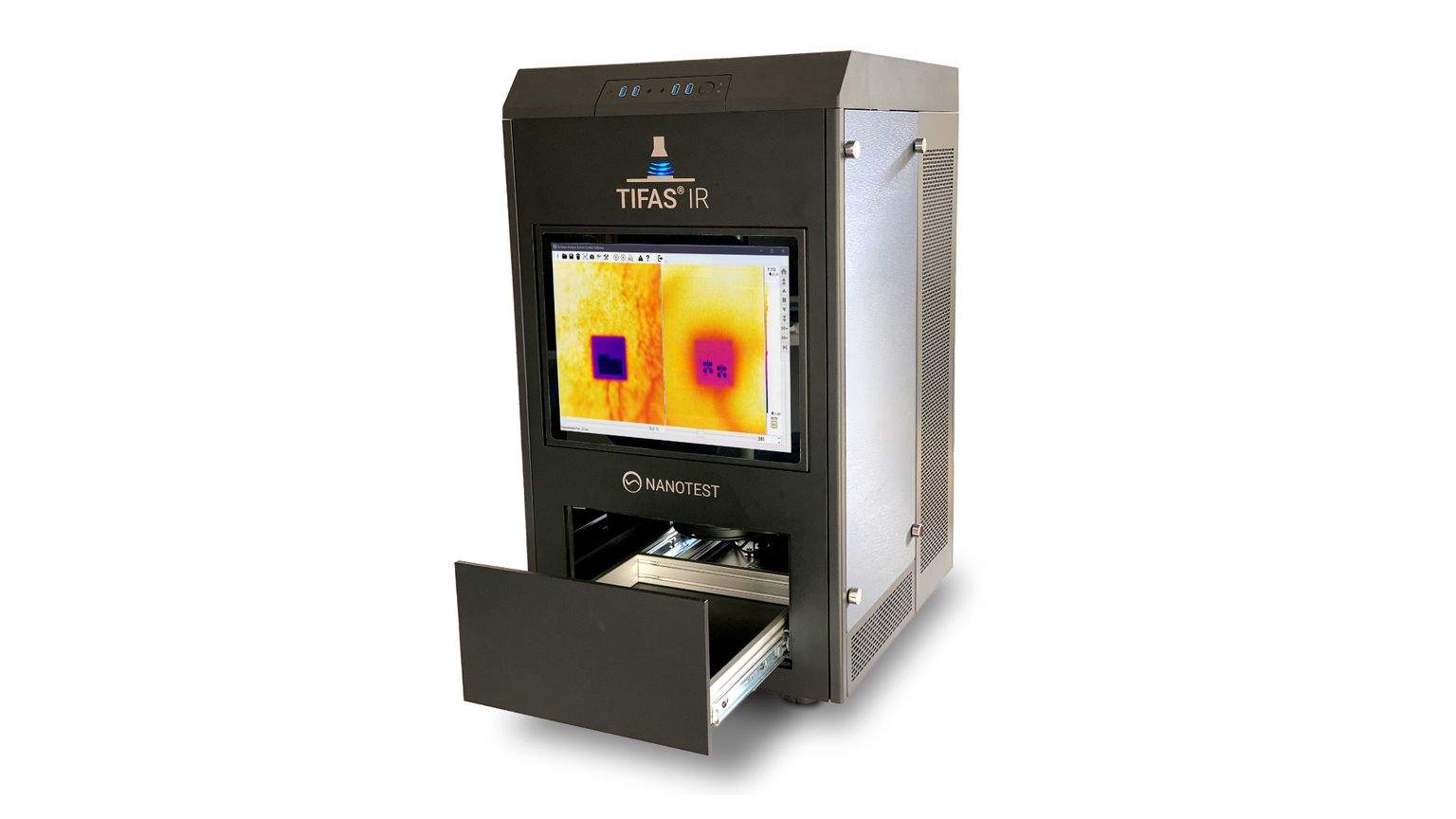
Why TIFAS IR Lab?
Electronic reliability hinges on the integrity of thermal pathways. With TIFAS IR Lab you get instant, non‑destructive insight into a component’s thermal behavior, letting you spot hidden defects before they cause failure.
- Speed – Pulse, pulse‑phase, and lock‑in thermography all in seconds.
- Precision – Image‑processing identifies even subtle anomalies.
- Versatility – Works with electrical parts, mechanical assemblies, and connections alike.
Pulse Thermography
A short, high intensity heat pulse is applied to the surface of the component under test. As the thermal energy propagates into the material, an infrared camera captures the transient surface temperature response. Subsurface defects, voids, delaminations, or poorly bonded interfaces, disrupt the heat flow and appear as thermal anomalies in the time resolved image sequence. The technique is fast, non contact, and well suited to large area screening.
Laser Lock‑In Thermography
A laser beam delivers periodically modulated optical excitation to the surface of the component under test. By correlating the resulting thermal response with the excitation frequency over many cycles, lock-in thermography extracts phase and amplitude images with very high sensitivity, well below the noise floor of a single-frame measurement. Defect depth can be probed by varying the modulation frequency. The technique is non-contact, spatially resolved, and applicable across a broad range of materials and component geometries wherever subsurface integrity needs to be assessed.
Electrical Lock-In Thermography
Rather than an external optical source, periodic electrical excitation is applied directly to the device under test. Joule heating generated at current-carrying structures or resistive anomalies produces a detectable thermal signal at the excitation frequency. Lock-in detection isolates this signal from background noise and steady-state temperature variations. The approach is especially powerful for localizing defects in electrically active components, including bond interfaces, interconnects, and power electronic devices, without any surface contact or optical access requirements.
Why Choose TIFAS IR Lab?
- Desktop‑Scale Lab – Bring full‑scale failure analysis into your office or lab.
- Comprehensive Control and Analysis Software – Data aquisition and image post processing
- Non‑Destructive & Contact‑Free – Preserve samples for repeat testing or further analysis.
- All‑In‑One Package – No need for multiple instruments; the system is ready to use out of the box.
What TIFAS IR Lab Detects
Voids
Cracks
Delamination
Inclusions
Foreign Objects
Custom Solutions
Every inspection challenge is different. We work closely with partners to develop tailored thermographic solutions for problems that fall outside the reach of standard methods, whether that means adapting excitation strategies, developing application specific processing algorithms, or integrating thermographic inspection into an existing workflow. If you have a specific defect detection, quality assurance, or failure analysis problem, we welcome the conversation.
Get in Touch!
Ask us for a quotation or about a custom application you have in mind.