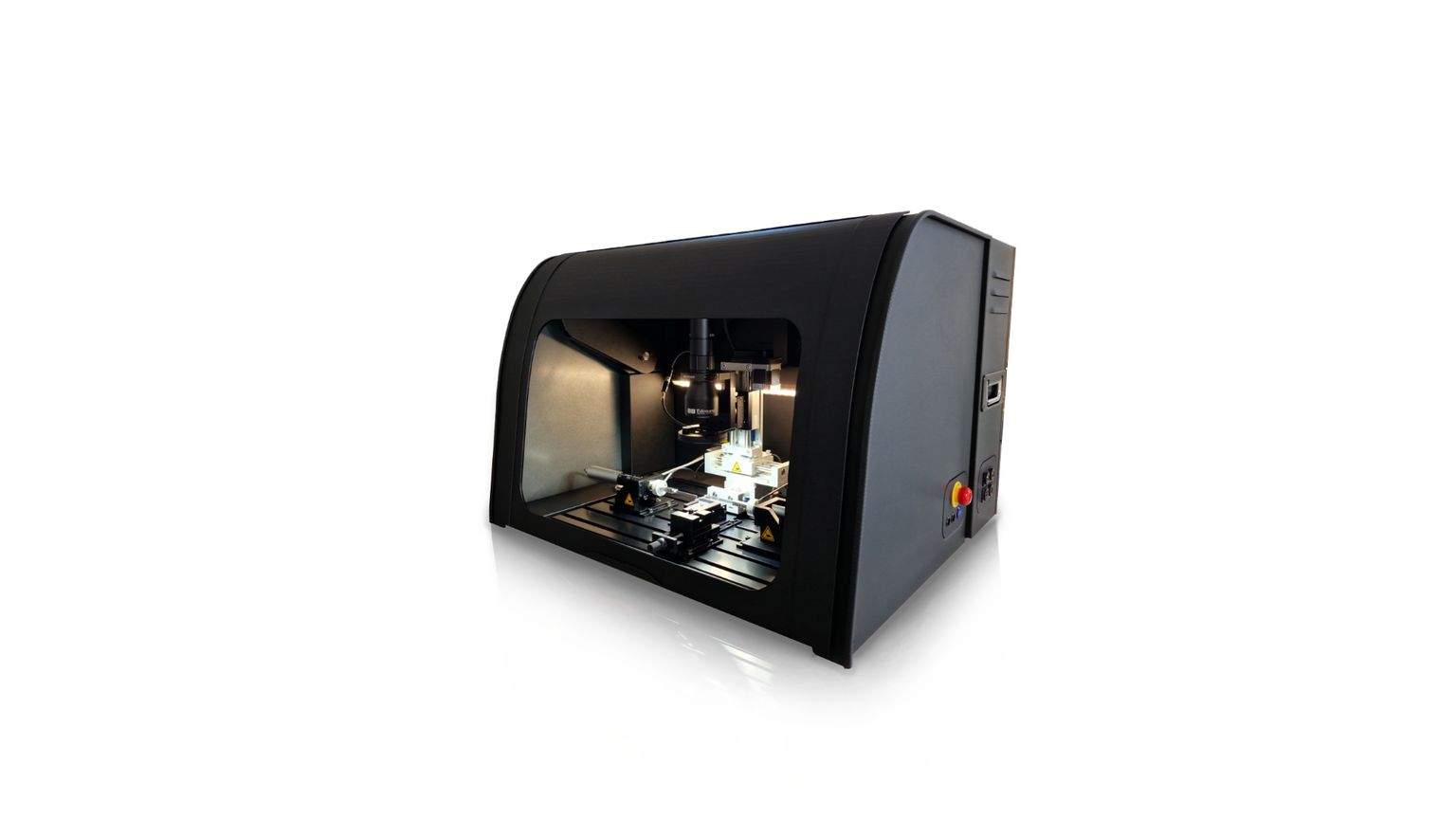
The AMB fracture test system is based on Advanced Mixed-Mode Bending and enables quantitative mixed-mode fracture testing of bi-material interfaces, package-near specimens and product-derived samples. By combining two independently controlled actuators, optical crack monitoring and FEM-supported evaluation, AMB determines critical energy release rates Gc as a function of mode mixity ψ. The result is fracture-mechanics-based interface data for material comparison, failure analysis and reliability-oriented simulation. Designed for small and delicate specimens, AMB helps bridge the gap between classical adhesion testing and realistic interface reliability assessment in electronic packages, automotive power modules, EV battery systems, bonded layers, laminates and advanced material systems.
From Adhesion Strength to Interface Fracture Data
Why mixed-mode characterization matters
In electronic packages, bonded layers and advanced material systems, interface failure is rarely governed by a single adhesion value. Delamination depends on mixed-mode loading, residual stresses, process history, loading rate and local material mismatch. Important contributors include thermal CTE mismatch, cure- or molding-induced shrinkage, moisture uptake and hygrothermal loading. These effects can generate residual stresses, modify the local stress state and change the apparent resistance of an interface against crack initiation and propagation.
Conventional adhesion tests often provide only an apparent strength value under one specific loading condition. For material development, process optimization, quality assurance, material and process mapping, reliability design and simulation-based validation, this is usually not sufficient. AMB addresses this gap by providing fracture-mechanics-based interface data under controlled mixed-mode loading. The system determines the critical energy release rate Gc and the corresponding mode mixity ψ, enabling Gc(ψ) curves for material comparison, failure analysis and reliability assessment.
Off the Package, Into the Tester
Realistic material characterization
Interfaces in real products rarely experience idealized loading conditions. They are affected by manufacturing processes, thermal history, residual stresses and local material combinations. The AMB fracture test system was developed for package-near interface characterization. Its specimen-centered design allows the evaluation of artificial bi-material specimens as well as samples extracted from real packages or manufactured under package-relevant process conditions.
The specimen is loaded primarily through compression. This reduces clamping and transfer effects that can become critical for small or delicate samples. With two independent actuators, AMB can access a broad range of mode mixity within one experimental framework. This reduces the number of required specimens and provides a direct route to Gc(ψ) curves for interface reliability assessment.
Application Areas
Interface reliability for electronic and advanced packaging, automotive power modules and EV battery systems
The AMB fracture test system is relevant wherever interface reliability limits product performance, lifetime or failure resistance. Typical application fields include semiconductor packaging, advanced packaging, encapsulant interfaces, underfills, adhesives, laminates and bonded material systems. In automotive power electronics, AMB can support the characterization of interfaces in power semiconductor packages, SiC power modules, IGBT modules, metal-ceramic substrates, encapsulant systems and bonded layers.
Beyond electronic packaging and electrification applications, AMB can also support small-scale interface characterization of structural adhesives, composite laminates and multi-material bonded systems. Typical use cases include material screening, surface pretreatment validation, process-window mapping, aging studies and local fracture characterization of product-derived coupon specimens. In EV battery systems, AMB can be applied to interface questions related to battery module adhesives, thermally conductive adhesives, thermal interface materials, structural bonding, cooling plate interfaces and cell-to-pack or cell-to-chassis concepts. The goal is to generate quantitative fracture-mechanics-based interface data for material comparison, failure analysis and FEM-supported reliability assessment.
AMB Advantages
Reduced Measurement Time
Gc (ψ) Curve From Two Samples
Standardized Fracture Mechanics
Key Features
- AMB fracture test system for mixed-mode interfacial fracture testing
- Designed for bi-material interfaces, bonded layers and package-near specimens
- Suitable for artificial specimens, process-representative samples and product-derived interfaces
- Two independent actuators for controlled variation of mode mixity
- Broad access to G–ψ data within a single experimental framework
- Compression-based specimen interaction to reduce clamping and transfer effects
- Optical observation of delamination progress during testing
- Crack length evaluation supported by image-based methods such as DIC or optical crack tracking
- FEM-supported calculation of critical energy release rates and mode mixity
- Applicable to semiconductor packaging, encapsulants, underfills, adhesives and laminates
- Relevant for automotive power modules, SiC/IGBT packages and power electronics reliability
- Relevant for EV battery pack adhesives, thermal interface materials and structural bonding interfaces
From Adhesion Testing to Interface Fracture Data
Conventional adhesion tests are often useful for screening, but they do not always provide the fracture-mechanics data required for predictive reliability assessment. AMB extends interface testing from apparent adhesion strength toward quantitative mixed-mode fracture characterization. By determining Gc(ψ), AMB provides data that can be used to compare material systems, investigate delamination mechanisms and improve simulation-based reliability models. This supports material development, process optimization, quality assurance and reliability-oriented design by providing quantitative interface fracture data under realistic mixed-mode loading conditions. The resulting data can be used to compare material systems, evaluate process variants, define acceptance criteria, build material and process maps, and improve FEM model validation, reliability prediction and virtual prototyping.
Ask Us For a Quote!
Push your mechanical characterization to the next level!